
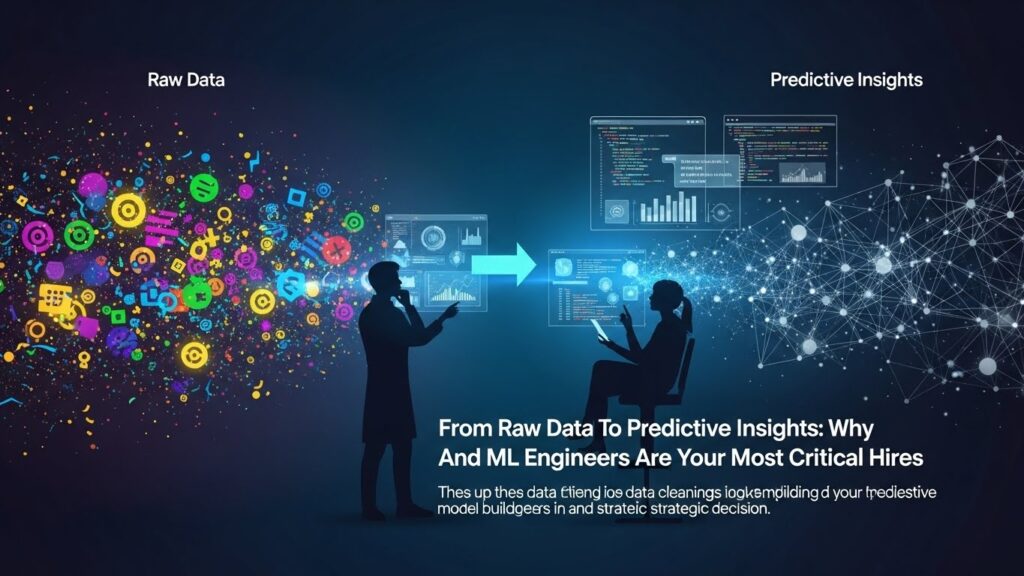

Data is an expensive liability until it becomes a predictable asset. Most organizations collect vast amounts of information but struggle to extract tangible business value from it. Without the right technical architecture and analytical rigor, data merely occupies cloud storage and increases operational overhead. The transition from holding raw data to generating predictive insights requires a specific set of engineering and scientific disciplines.
To navigate this complexity, modern enterprises prioritize specialized talent for their technical teams. Many organizations choose to hire machine learning engineer professionals to build the infrastructure required for scalable model deployment. Simultaneously, they hire data scientists to design the statistical frameworks that uncover hidden patterns within their information. These roles are not interchangeable, yet they are the two most essential components of an advanced data strategy.
Securing a data scientist for hire is often the first step for a startup looking to validate product hypotheses through statistical evidence. As these models move toward production, finding a hire machine learning developer becomes necessary to ensure that the code is robust and performs well under heavy user loads. These hires represent the bridge between theoretical possibilities and the reality of a functioning product.
The Distinction Between Data Science And Machine Learning Engineering
Understanding the specific responsibilities of these roles is vital for any leadership team. While both positions work with data and algorithms, their objectives and daily workflows differ significantly.
The Role Of The Data Scientist
A data scientist functions as a researcher and a statistical navigator. They start with a business question and look for evidence within the data. Their work involves exploratory data analysis to identify correlations, trends, and anomalies.They are responsible for cleaning data and choosing the right mathematical models to represent real-world events. Their goal is to provide clarity and foresight to stakeholders.
The Role Of The Machine Learning Engineer
A machine learning engineer is a software engineer with a specialty in artificial intelligence systems.Once a data scientist builds a successful model prototype, the engineer takes over. They convert that prototype into production-ready code. This involves optimizing for latency, managing memory consumption, and ensuring the system can handle millions of requests. They focus on the architecture that allows models to function in a live environment.
The Lifecycle Of A Predictive Model
The journey from a spreadsheet to a predictive feature involves several technical stages. Each stage requires the unique skills of both scientists and engineers to prevent the system from failing.
Data Ingestion And Feature Engineering
Before any prediction occurs, data must be collected and refined. This stage is known as feature engineering. It involves selecting the specific variables that influence a model’s performance. A data scientist identifies which factors matter. An ml engineer builds the pipelines to ensure this data flows into the system accurately and without delay.
Training And Validation
Training a model is an iterative process.It involves running data through algorithms to see how well they predict known outcomes. Data scientists focus on the accuracy and precision of these results. They use a variety of metrics, such as the f1-score or the area under the curve, to determine if a model is reliable.
$$F1 = 2 \cdot \frac{\text{precision} \cdot \text{recall}}{\text{precision} + \text{recall}}$$
Deployment And Monitoring
Once a model is validated, it enters the production environment. This is the domain of the ml engineer. They implement continuous integration and continuous deployment (ci/cd) pipelines specifically for machine learning, often referred to as mlops. They monitor for model decay, which happens when the real-world data starts to change and the model’s predictions become less accurate over time.
Why Startups Need Both Roles For Sustainable Growth
Startups often make the mistake of hiring a generalist who tries to cover the entire data lifecycle. While this might work for a small prototype, it leads to significant technical debt as the business scales.
Avoiding Technical Debt
Technical debt in machine learning is often more complex than in traditional software.It can manifest as hidden feedback loops or data dependencies that are difficult to untangle. A dedicated ml engineer ensures that the codebase is maintainable. They apply software engineering best practices that a research-focused scientist might overlook.
Turning Data Into A Competitive Edge
Predictive insights allow a company to move faster than the market.Instead of looking at what happened last month, leaders can see what is likely to happen next week. This foresight informs inventory management, customer acquisition strategies, and risk assessment.Without these critical hires, a company is essentially driving using only the rearview mirror.
Vetting The Right Talent For Your Team
Finding high-quality talent in the current market requires a nuanced approach. Since these roles are in high demand, identifying the difference between a resume with keywords and a professional with experience is crucial.
Evaluating Technical Depth
When looking to hire, focus on practical problem-solving rather than academic credentials alone. A strong candidate should be able to explain the trade-offs between different architectures. For instance, an ml engineer should be able to discuss why they might choose a specific cloud service over another for hosting a model. A data scientist should be able to justify their choice of a specific algorithm for a given dataset.
The Importance Of Communication
Technical skills are only half of the equation. A data scientist must be able to translate complex findings into language that a marketing or product team can understand. If they cannot explain why a model is predicting a certain outcome, the business cannot act on that insight with confidence.
The Long Term Impact Of Predictive Hiring
Investing in these roles changes the internal culture of a business. It shifts the company away from gut-feeling decisions toward a culture of evidence-based strategy. As the amount of data in the world grows, the ability to process it efficiently becomes the defining factor between leaders and laggards.
When you hire machine learning engineers and data science talent, you are not just adding headcount. You are building a system that learns and improves over time. This creates a compounding effect where your product becomes more intelligent and efficient with every user interaction.
The technical foundation established by these professionals allows for the integration of more advanced technologies later on. It ensures that as the business evolves, the data infrastructure remains a source of strength rather than a bottleneck.